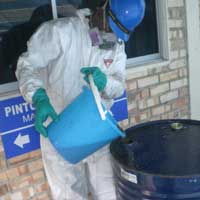
ASBESTOS SURVEY, ASSESSMENT & REMOVAL
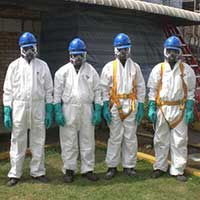
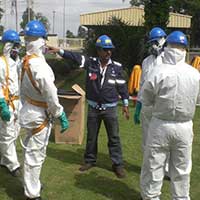
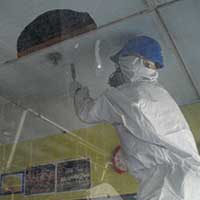
“Asbestos” is the fibrous form of mineral silicates belonging to the serpentine and amphibole groups of rock-forming minerals, including actinolite, amosite (brown asbestos, cummingtonite, grunnerite), anthophyllite, chrysotile (white asbestos), crocidolite (blue asbestos), tremolite or any mixture containing one or more of these materials. Asbestos has, in the not too distant past, been commonly used in certain products that include building materials and for industrial plant applications, primarily due to its inherent and extraordinary heat-resistant or corrosion-resistant properties.
Asbestos-containing material (ACM) refers to any non-friable material which contains 1% or greater asbestos, or friable material which contains 0.1% or greater asbestos. Asbestos dust refers to particles of asbestos or settled particles of asbestos which may become airborne in the working environment. Asbestos fiber refers to a particle of asbestos greater than 5 micrometers in length, with a minimum length to diameter ratio of 3 to 1.
Asbestos fibers that are released from asbestos-containing material into the airspace during construction or abatement activities can remain airborne for prolonged periods of time. The inhalation of asbestos fibers can eventually lead to three specific diseases: asbestosis (a fibrous scarring of the lungs), lung cancer, and mesothelioma (a cancer of the lining of the chest or abdominal cavity. The symptoms of the above diseases may appear 20 years or more after exposure; however, high levels of exposure can result in respiratory diseases in a shorter period of time. Most health problems resulting from asbestos exposure are attributed to workers who have been exposed to airborne asbestos over a prolonged period without the worker protection that is now required by appropriate legislation.
However, it should be taken note that the mere presence of asbestos in a building does not mean that the health of building occupants is endangered. Intact and undisturbed asbestos materials generally do not pose a health risk. ACM which is in a good condition, and is not damaged or disturbed, is not likely to release asbestos fibers into the air. The risk of asbestos exposure is greatly increased during asbestos abatement work.
The survey for asbestos containing materials at the production facility shall be conducted in conformance with the requirements established by the United States Environmental Protection Agency (USEPA) and as per ASTM E 2356-04, Standard Practice for Comprehensive Building Asbestos Surveys.